Nollywood Deserves a Cinema in Every Pocket
Nollywood is the second-largest film industry in the world – not second on the continent, second globally, behind Bollywood and ahead of Hollywood. We produce roughly 2,500 films a year. In 2024 the Nigerian box office hit ₦11.5 billion, a 60% jump from the previous year, and Q1 2025 alone pulled in ₦3.48 billion which was a 132% increase over the same quarter in 2023. These are not small numbers for an industry that most of the world still treats as a footnote.
But here's what's strange about all of this: the average Nigerian filmmaker genuinely has no idea how many people watched their film last night. And that, more than anything else, is what led me to build Mosion.
The way distribution actually works for most Nollywood filmmakers is something I spent a long time trying to understand. You make a film – which takes months, usually over a year once you factor in funding – and then you start knocking on doors. If a streaming platform picks you up, you're looking at somewhere between $10,000 and $90,000 from Netflix for a one-time licensing deal. You sign over the rights, they control the audience relationship, and you never see a single piece of data about who actually watched it. Most filmmakers take the money, move on, and hope the next deal is better.
For the many who don't land that deal, the options narrow quickly. YouTube can get you views but rarely gets you paid – a million views might earn you ₦200,000 on a good day. The cinema circuit requires studio backing that most independent filmmakers simply don't have access to.
And underneath all of this is piracy, which is eating the industry alive. UNESCO estimates that 50 to 70% of Nigeria's film revenue is lost to piracy, and the World Bank found that for every legitimate copy of a Nigerian film sold, nine others are pirated. The Nigerian Copyright Commission puts the annual digital piracy losses at over ₦150 billion. What used to be pirated DVDs is now Telegram channels and WhatsApp forwards – the format changed, but the problem didn't go anywhere.
The result is genuinely frustrating: an industry growing at 60% a year, with individual filmmakers who often can't recoup what they spent making their last film before they need to start funding the next one.
The conventional answer, for most of the last decade, was to build an African Netflix – aggregate content, grow subscribers, and let the model do its work. Showmax was the most serious attempt at this, and it shut down on April 30, 2026, having burned through $265 million. Amazon Prime Video had already pulled back from African original content before that, and Netflix, which is still around, has significantly slowed down its commissioning of African originals.
I genuinely don't think the problem was the content. The content is good – often great. The problem is that the subscription model was designed for a very specific economic context that just doesn't describe most of Africa.
Subscriptions assume reliable broadband, widespread credit card penetration, and households that are comfortable with money leaving their account every month regardless of whether they used the service. In much of Nigeria, people bank on their phones, buy data in small bundles as they need it, and often share one device across a whole household. A recurring monthly charge is the kind of commitment that gets dropped the moment money gets tight, and you can't build a media business on revenue that disappears whenever your audience needs it most.
What's interesting is that the transactional model Nigerians already use for everything else – rides, food, airtime, data – is exactly the model that makes sense for film too. You see something you want, you pay for it. No subscription, no library you feel guilty about not using, no monthly charge quietly going out.
For film lovers, that's a simpler and more honest deal. But the more important change is what it does for filmmakers.
When a title goes up on Mosion, the filmmaker earns every time someone buys it – not a one-time licensing fee but actual ongoing revenue tied directly to how many people watch their work. They can see their audience: where viewers are coming from, what they watched before, how the film performs week over week. They control the price and they own the relationship. It's a fundamentally different setup from one where a platform takes the rights and the filmmaker just waits to see if the next deal is better.
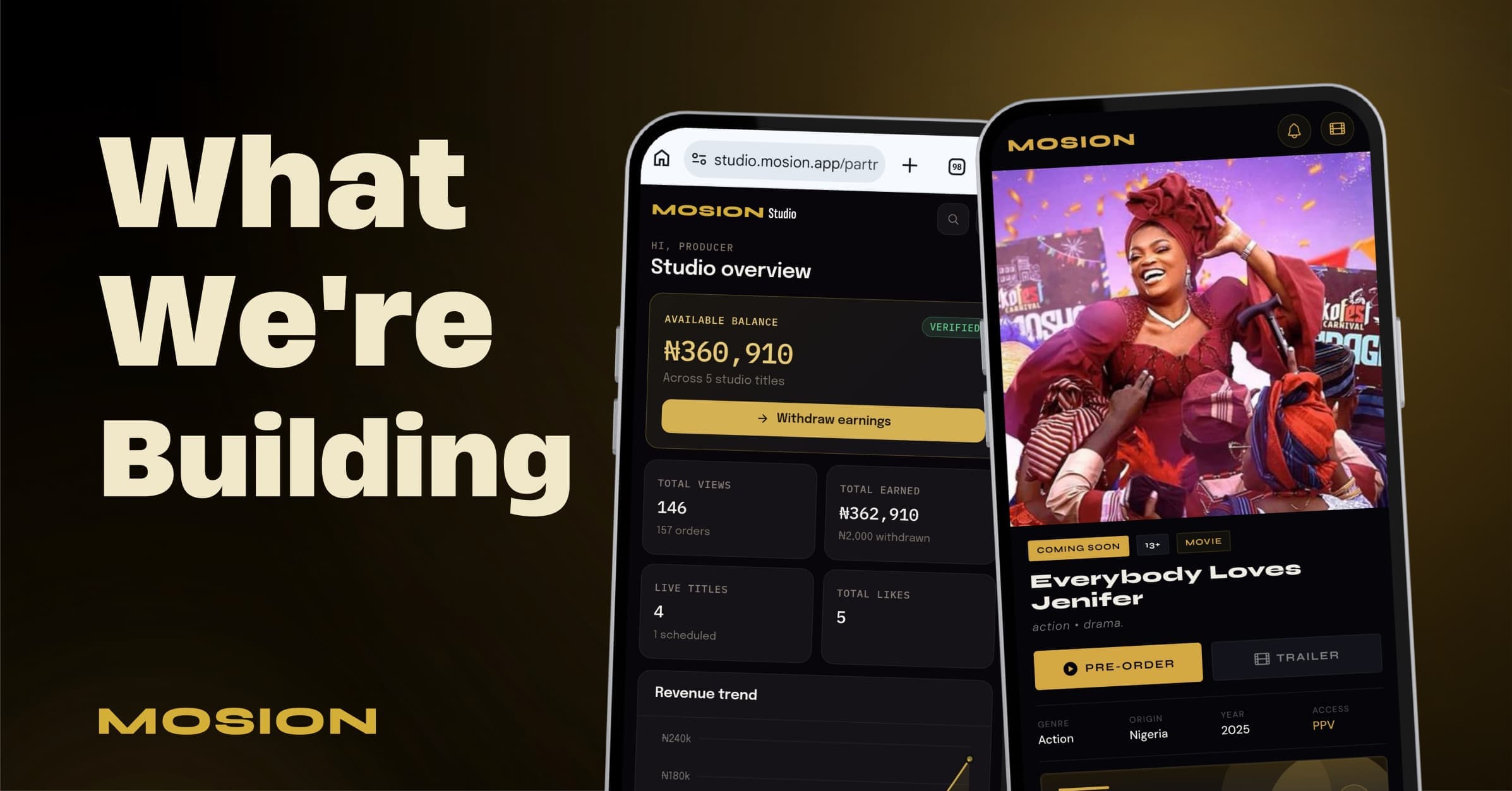
Mosion is a pay-per-view platform built for African film. On the viewer side it's a mobile-first app where you can discover and stream African titles without a subscription – you buy what you want when you want it. On the filmmaker side there's Mosion Studio, a dashboard where you can submit your titles, set your own pricing, see how your content is performing, and withdraw your earnings directly.
We're in public beta right now with over 100 testers actively using the product. It's been a genuinely useful process – some things we were confident about turned out to need more work, and some things we were uncertain about landed well. The product we're building toward the full launch is meaningfully better than where we started.
The content quality in Nollywood right now is as high as it's ever been. The 2024 box office didn't break records by accident – the storytelling, the production, and the ambition are all at a different level than they were five years ago. The gap has never been about the films.
What's shifted is that the global platforms are stepping back at the same time. Showmax is done, Prime Video has pulled back, and Netflix is tightening. That creates a window for a platform built specifically for this market – one that doesn't need $265 million to run an experiment, because it's not trying to replicate a model designed for a different context.
The payments infrastructure is also finally there. Flutterwave and Paystack have made seamless mobile-first payments genuinely workable across Nigeria in a way that just wasn't true in 2015. The technical barriers to making transactional video work at scale are mostly gone now.
If you're a filmmaker, I'd love to have your content on Mosion – not for a one-time fee and a handshake, but because we want to build the kind of platform where you actually earn from your work every time someone watches it.
If you're an investor or a media operator thinking seriously about where African content distribution goes from here, I'm very open to talking.
And if you just love these films – if you grew up on them, if you share them, if you've ever felt like the stories that look and sound like your life are somehow harder to find and harder to support than they should be – this is what we're building for you.
Filmmakers can get started at studio.mosion.app. Movie lovers, your cinema is at mosion.app.